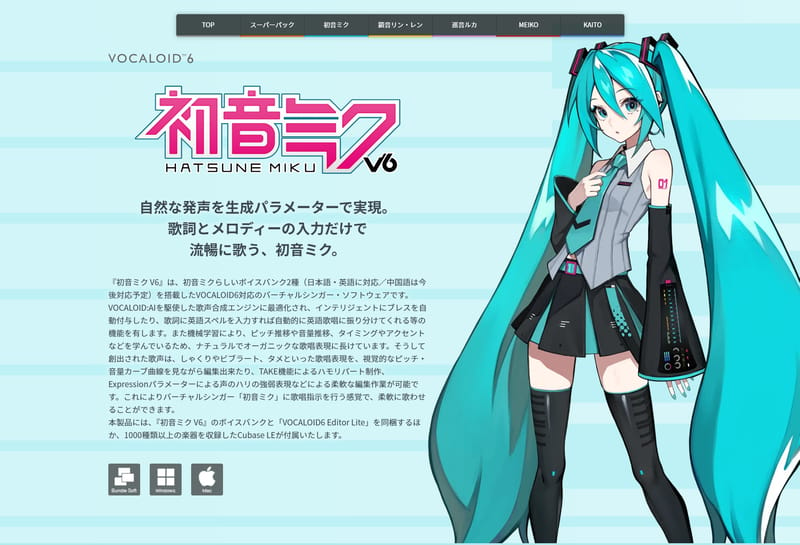
Crypton and Yamaha developers explain how Hatsune Miku V6 recreated Miku-like vocals with AI
Summary
Crypton and Yamaha developers explain how Hatsune Miku V6 recreated Miku-like vocals with VOCALOID:AI, why Original and Soft were included, and how the same voice was brought to Mobile VOCALOID Editor with bidirectional sequence transfer but separate licenses.
An in-depth development interview on Hatsune Miku V6 was published by DTM Station on July 22, 2026, and introduced by the VOCALOID official X account on July 26. The interview brings together Crypton Future Media producer Wataru Sasaki, SONICWIRE music business team manager Masamichi Koizumi, and Yamaha VOCALOID Group members Keijiro Saino and Masashi Yoshida.
Hatsune Miku is a character owned and managed by Crypton Future Media; Yamaha provides the VOCALOID6 singing synthesis technology and Editor. The article states that Hatsune Miku V6 for VOCALOID6 was officially released on April 14, 2026 with two voicebanks, Original and Soft, after a project that began with exchanges in late 2023 and full work from spring 2024.
Key development points disclosed: Yamaha proposed reusing existing vocal assets and VOCALOID technical knowledge, as ранее used for ZOLA Project, to preserve Miku-like qualities while using the VOCALOID:AI engine; Saino handled learning-data creation and parameter tuning, adjusting timing models and learning parameters rather than rebuilding the engine; Sasaki and Saino repeatedly compared samples to decide what counts as acceptable Miku-ness versus technical quirks; Soft was created by fine-tuning from the Light Append-based voice and added at the last minute before the February package deadline; LAM illustrated the package after discussions on AI and Miku's future.
The interview also covers Mobile VOCALOID Editor: Version 2 in October 2025 enabled VOCALOID:AI support and worldwide sales, allowing Hatsune Miku V6 to be ported to mobile. The mobile version uses essentially the same engine as the PC version, with some usability differences, and produces nearly identical singing. Sequence data can move bidirectionally between PC and mobile, but voicebank licenses must be purchased separately for each platform.
Early Access demo Prism received a warm reception, which the developers describe as validating the approach. Piapro Studio NT2 and VOCALOID6 project-file interoperability is also mentioned as already implemented.
Read the original